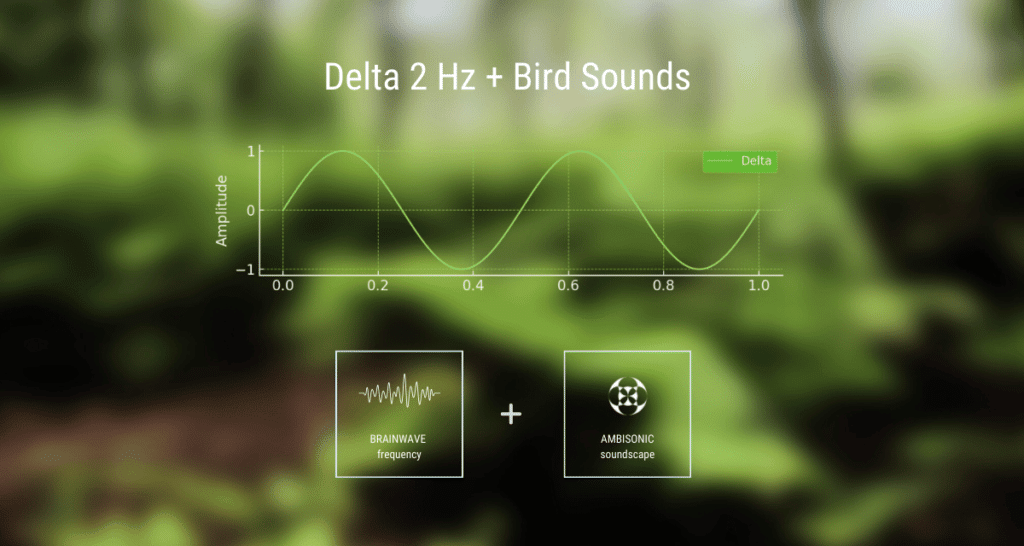
If you’re about to listen to binaural beats for the first time, it’s good to first understand what they actually are, because there’s a lot of confusion around them. Very simply put, a binaural beat is not music. It’s not the ambient sound you hear, not the nature sounds, and not the atmosphere around it.
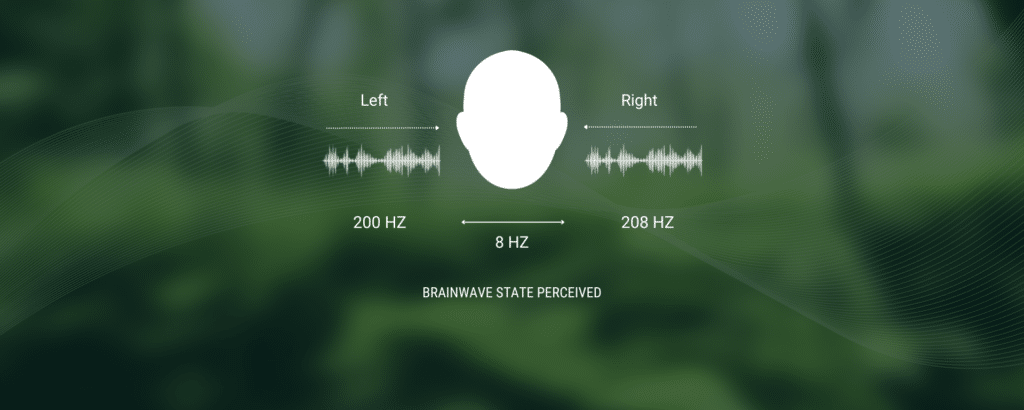
A binaural beat is created when one frequency is played in one ear, and a slightly different frequency is played in the other ear, always through headphones. Your brain then does something interesting: it perceives a third rhythm, a kind of internal pulse. That perceived pulse is the binaural beat. So if your left ear hears 100 Hz and your right ear hears 104 Hz, your brain perceives a 4 Hz beat. That beat does not exist in the audio itself; it exists in your brain. The idea is that your brainwaves then entrain to the “beat,” creating your desired brain state.
There is one important limitation: The difference between the two tones cannot be too large. If the difference is more than roughly 40 Hz, the brain no longer perceives it as a beat, it just hears two separate tones.
One Beat, Many Possibilities
Something that’s often misunderstood is that the binaural beat is only the difference between the two ears, nothing more. That means you can create a 4 Hz binaural beat in many different ways:
-
100 Hz in one ear and 104 Hz in the other
-
200 Hz and 204 Hz
-
400 Hz and 404 Hz
The beat is still 4 Hz each time. What changes is the base tone, the pitch you hear underneath.
On top of that, you can decide:
-
how loud the beat is
-
whether you hear it clearly or barely at all
-
what kind of sounds surround it like ambient music, drones, nature sounds, or silence
This is why binaural beat tracks can sound completely different from each other, even if they technically use the same beat frequency.

Why It’s Often Confused with Music
Many people think that the ambient music itself is the binaural beat. That’s understandable, because binaural beats are often hidden inside calm, subdued soundscapes. But technically speaking, the music or nature sounds are not the binaural beat. They are the environment around it.
In theory, and this is important, binaural beats should work the same way regardless of the surrounding sound. Even if you were listening to hard rock (assuming you don’t have an aversion to it), the binaural beat mechanism itself would still be the same.
In practice, however, the surrounding sound matters a lot for how you experience it. Ambient music and nature sounds are already relaxing for most people, so they naturally support relaxation, safety, and ease. That’s one of the reasons they’re often used.
Brainwaves and Intent
Binaural beats are usually linked to so-called brainwave ranges. These are not exact points, but ranges, and that’s important to remember.
-
Delta (≈ 0.5–4 Hz)
Deep sleep, physical restoration
-
Theta (≈ 4–8 Hz)
Meditation, deep relaxation, hypnagogic states
-
Alpha (≈ 8–12 Hz)
Calm awareness, relaxed focus
-
Beta (≈ 12–30 Hz)
Active thinking, focus, problem-solving
-
Gamma (≈ 30 Hz and up)
Higher cognition, integration, peak performance
When people say “this is an alpha track” or “this is theta,” what they really mean is that the difference between the ears falls somewhere in that range. But even within one category, there can be many different beats. An alpha beat of 8 Hz feels very different from one of 11.5 Hz — even though both are still “alpha.”

How Long Should You Listen?
Research suggests that around 20 minutes of listening can be effective, but this is not a strict rule. Interestingly, a lot of meditation research also points to 20 minutes as a meaningful duration regardless of binaural beats. So it’s likely that time spent in a focused or relaxed state plays an important role too. The most honest answer is: listen long enough to notice what it does for you.
Why There’s No Perfect Formula
Despite a lot of experiments, there is no solid scientific consensus on:
-
which base frequencies work best
-
how loud the beat should be
-
how it should be mixed with other sounds
-
or whether 100/104 Hz is “better” than 200/204 Hz
Most research focuses on the difference frequency, not the carrier tones or the sound design around it.
That means a lot is still left to the maker’s choices and the listener’s experience.
How We Approach Binaural Beats
In our work, we choose frequencies that we find pleasant and perceivable. We want you to be able to hear that something is happening without it becoming uncomfortable or distracting.
We mix binaural beats with nature sounds, because nature sounds on their own already help many people feel calmer, more grounded, and safer. For us, that combination feels supportive rather than intrusive.
But ultimately, binaural beats are something you need to explore yourself.
Pay attention to:
-
how different base tones feel to you
-
whether you like hearing the beat clearly or subtly
-
which frequency ranges support your intention
There is no single correct way to listen. In the end it is your experience that matters.
Want to try binaural beats combined with nature sounds? Listen to Nature Brainwaves.
Read more in our other article about Binaural Beats here.
Go to our shop and listen Nature Brainwaves here
Related reading from the journal
- Spatial Audio for Curious Ears (part 1) – the plain difference between mono, stereo, multichannel and 3D audio, one format at a time.
- Integrity of our Sonic Tools: What You Hear Is What You Get – why we check that a claimed frequency is actually in the recording before we name it.