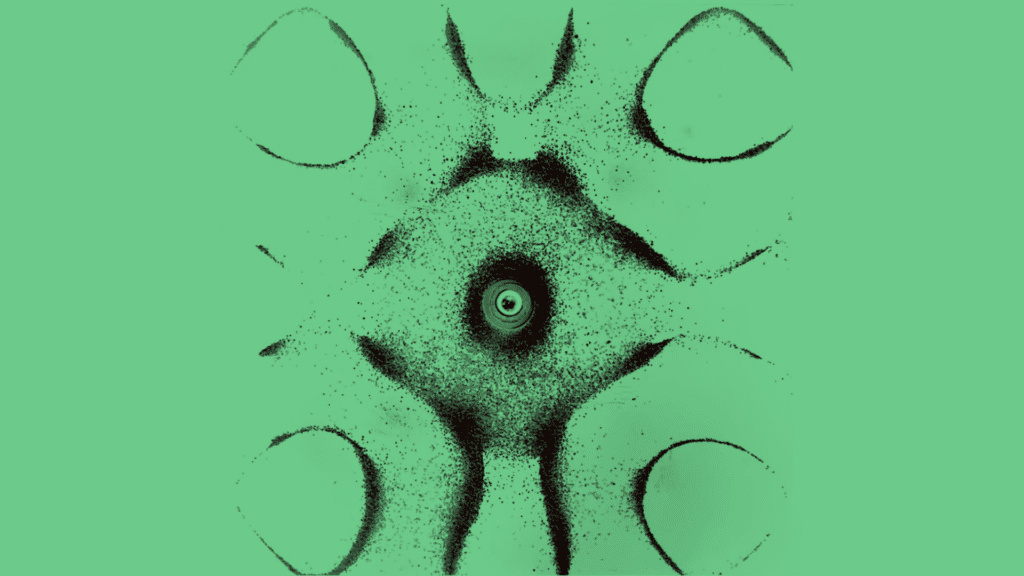
Cymatics is the study of visible sound and vibration patterns and a subset of modal vibrational phenomena. As Collins dictionary says: the study of wave phenomena, esp sound, and their visual representations.
It explores how sound waves interact with different materials to create geometric patterns and shapes. The term “cymatics” was coined by the Swiss physician and natural scientist Hans Jenny in the 1960s, derived from the Greek word “kyma,” meaning “wave.” Simply put it makes sound visible or better say it makes vibrations visible and each frequency of vibration has its visible pattern.
Basics
The basic principle of cymatics is that when sound waves pass through a medium, such as water, sand, or a metal plate, they create distinct patterns that can be seen and studied. These patterns are formed due to the vibrations caused by the sound waves, which cause the medium to move in specific ways.
Leonardo da Vinci noted that when a table is struck, the dust on it gathers into small mounds. Galileo found that a brass plate scraped with a chisel until it whistled was left with evenly spaced streaks, closer together when the pitch was higher. The first systematic study came from Ernst Chladni, a German physicist and musician, who published Entdeckungen über die Theorie des Klanges in Leipzig in 1787. Chladni conducted experiments using a metal plate covered with a thin layer of sand. By drawing a bow along the edge of the plate, he caused it to vibrate, and the sand rearranged itself into intricate geometric patterns, known as Chladni figures. Chladni’s work demonstrated the visual representation of sound and laid the foundation for further exploration in the field of cymatics.
Hans Jenny expanded upon Chladni’s experiments and conducted extensive research on cymatics. In the 1960s, he published a book called “Cymatics: A Study of Wave Phenomena and Vibration,” which documented his findings. Jenny used various materials, including fluids, powders, and pastes, to visualize the effects of different sound frequencies and amplitudes on the medium.
To make sound visible most of the time there are two different kinds of devices used. One is the Chladni plate which is a metal plate with “dust” on it or a device that is essentially a bowl of water on top of a speaker with a camera. Especially with the last one the most beautiful images of specific frequencies are captured.
Harmony
What is interesting is that when pure frequencies are played, the material used forms the most beautiful shapes that are based on geometry and can resemble nature, flowers, and ancient symbols and patterns. Besides the somewhat mysterious that something (sound) invisible to the eye can become visible it is also this “beauty” and harmony effect that draws people into the study of cymatics.
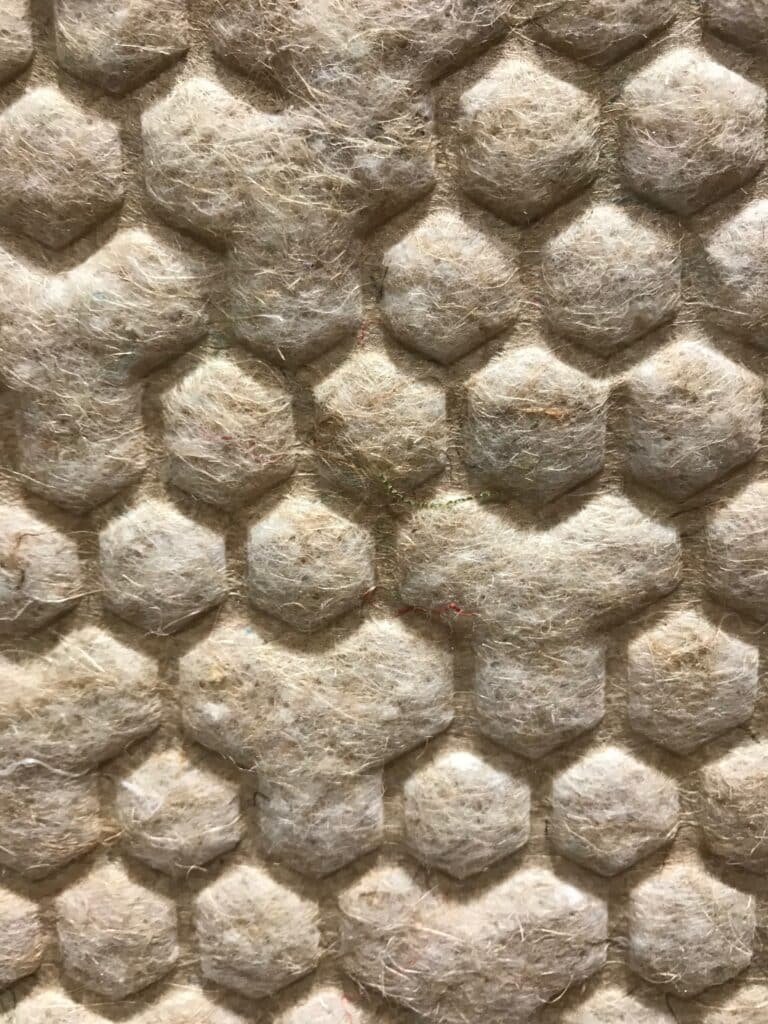
The hexagon is one of the shapes that turns up, and we gave it an article of its own.
A lot of sound healing practice rests on an inference drawn from this: if pure frequencies form ordered figures in water, the reasoning goes, they will do something comparable in the body. It is an appealing idea and it is worth naming it as an inference rather than a finding. What cymatics actually demonstrates is that sound organises matter, which is a real and visible thing. What it does inside the body is a separate question, and cymatics cannot answer it.
_____
How Standing Waves Are Formed (Chladni Plates Example)
Vibration
- A vibration is applied to a plate (typically metal) using a bow or a speaker that generates mechanical waves.
Resonance
- Every plate has its resonant frequencies; when the vibration hits one of these frequencies, the entire plate resonates.
- This causes intense propagation of elastic waves across its surface.
Standing Waves
- The generated waves reflect off the edges of the plate, overlapping one another.
- Certain points (called nodes) experience destructive interference and remain relatively still, while others (called antinodes or loops) experience constructive interference and vibrate more intensely.
Pattern Formation
- If sand or another lightweight material is sprinkled on the plate, it migrates toward the nodes, where vibration is minimal.
- As a result, the grains accumulate into characteristic geometric patterns known as Chladni figures.
- In essence, standing waves arise from the constructive and destructive interference of reflected waves, resulting in specific areas of stillness (nodes) and maximum vibration (antinodes). Chladni figures are a visual expression of these node patterns, made visible by the redistribution of sand.
_____
Water
An interesting addition to this topic is the work of Masaru Emoto, who reported that human thoughts, words and feelings influence how water crystallises. Using a microscope, he photographed crystals forming in frozen water and reported that water from clear springs, and water exposed to loving words, produced brilliant and complex snowflake patterns, while polluted water, or water exposed to negative thoughts, produced incomplete and asymmetrical ones.
Most people do not consider this science, and the reasons are fair. In Emoto’s own work the photographers knew which water had received which words and chose the most pleasing crystals. Two later blinded tests reported a small effect, but Emoto was a co-author on both, and no independent group has reproduced the result as far as we can find. That is the contrast with the Chladni plate, where the same plate at the same frequency gives the same figure for anyone who tries.
The recreation problem may be part of the point. A frequency is a fixed, measurable thing. An intention is not. Everyone holding the same intention is doing so from a different body, which would make the experiment very hard to repeat under any conditions. That is a possible explanation rather than a defence. It depends on what you think is being measured.
The same care is worth taking with 432 Hz, where a good story has outrun the evidence in a similar way.
The name Flower of Sound
The name Flower of Sound is inspired by Cymatics and the beautiful flower shapes sound can make.
From Visible Sound to Immersive Sound
Cymatics shows us what sound does to matter outside the body: sand organising into geometry, water forming patterns that mirror nature. The next question is a natural one: what does sound do inside the body, and does the way we listen change the effect? Stereo, the format most people use, reduces three-dimensional sound to two flat channels. Immersive audio restores the spatial character that stereo removes, and it turns out that the difference is neurological, not just aesthetic. If you’re curious about the science and what it actually means for how you experience nature sounds, the next article picks up where this one leaves off.
Why Nature Sounds Feel More Real in 3D — And What That Does to Your Body
Being straight about what sound does, and what it does not, is the whole basis of how we build our Sonic Tools.
Related reading from the journal
- Where the fascination with 110 Hz comes from – resonance measured in places built long before anyone could describe it.
The books to read for more information about Cymatics
- Jenny, H. (2001). Cymatics: A Study of Wave Phenomena and Vibration. Macromedia Press. You can read the book here: https://archive.org/details/hans-jenny-cymatics/page/113/mode/2up
- Chladni, E. F. F. (1787). Entdeckungen über die Theorie des Klanges. Weidmanns Erben und Reich. You can read the book here: https://archive.org/details/entdeckungenuber00chla
- Masaru Emoto “The Hidden Messages in Water”. This one you can order on all online bookshops.
- Alexander Lauterwasser, “Water Sound Images”
- Scientific studies on sound-matter interaction (Journal of the Acoustical Society of America)