Philosophical and Mystical Approaches to Music and Altered States
In this second part of the From Ecstasy to Trance series, I explore how ancient philosophy and Islamic mysticism have approached the relationship between music and trance, understood not as a diffuse metaphor but as a structured, relational state of consciousness. I draw from the thought of Plato and Al-Ghazali, as well as various ethnographic cases discussed by Gilbert Rouget.
My aim is not to describe musical ecstasy as a general experience, but to trace how specific sound practices were coded, feared, or ritualized within systems of meaning and embodiment. I am writing this because, with Flower of Sound and for myself, From Ecstasy to Trance is one of the pillars of our catalog and a vast source of inspiration. The terms Ecstasy and Trance are often used lightly and with a misguided meaning, and in this series, I want to get into the depths of them.
What is Trance
Music has always had the potential to act not only as art, but as a medium of transformation. In contexts of trance, this potential becomes explicit. But what exactly do I mean by “trance”? I’m not referring to metaphorical absorption or aesthetic rapture, but to the culturally framed alteration of perception, often involving rhythmic repetition, bodily activation, and symbolic function.
Following Gilbert Rouget’s fundamental distinction between ecstasy and trance (Rouget, 1985), I focus here on trance as an interactive state, one that requires not only music but a ritual context, an intention, and a relationship. To do so, I look at two radically different but equally rich traditions: the ancient philosophical discourse on musical modes, and the Islamic mystical practice of samaʿ as discussed by Al-Ghazali.
Plato and the Modes: Regulating Sound, Avoiding the Collapse
In The Republic (Book III, 398-403), Plato outlines a detailed ethics of musical modes. The Dorian mode is associated with courage and firmness in adversity. Contrary to what was previously stated, Plato does not reject the Phrygian mode. He retains both the Dorian and the Phrygian, associating the latter with different contexts, including persuasion, prayer and religious feeling.
Aristotle, however, takes a different position. In Politics Book VIII, he explicitly criticises the Socrates of The Republicfor retaining the Phrygian mode alongside the Dorian. Aristotle describes the Phrygian as emotionally exciting and closely associates it with the aulos, Bacchic frenzy and similar ritual states.
The distinction is not only musical. In Aristotle, the association between the Phrygian mode, the aulos and Bacchic ritual gives it a strong emotional and symbolic dimension.
The reconstruction of ancient Greek modal structures remains debated. Samuel Baud-Bovy explicitly explored the hypothesis of a pentatonic Dorian mode in his 1978 study Le dorien était-il un mode pentatonique ?. This should not be taken as a settled reconstruction of ancient Greek music, but as one contribution to a much broader musicological debate.
What matters here is not how these modes sound today but what they represented within these ancient systems of thought. For Aristotle, the Phrygian mode was not a direct cause of trance, but it was closely associated with emotional excitation, the aulos and Bacchic ritual.
As Rouget notes: “The music of possession does not produce trance because of its sound. It serves as the most visible sign of an identity that breaks from the norm.”

Al-Ghazali and the Voice That Penetrates
Turning to Al-Ghazali, I find a radically different attitude. In his Ihyaʾ ʿUlum al-Din, particularly the Book of Samaʿ, Ghazali offers a qualified defence of music and recitation within Sufi practice. His focus is not on social regulation, but on internal transformation.
For Ghazali, a beautiful voice reciting words of truth can lead to physical and emotional manifestations such as trembling, weeping and fainting. Within the spiritual context of samaʿ, these manifestations may be understood as signs of spiritual receptivity rather than simply as pathological states.
But the power of samaʿ does not lie simply in music itself. It emerges from a convergence of elements: the beauty of the voice, melody and rhythm, the meaning of the words, and the disposition of the listener. A beautiful voice can move what is already present within the heart, while familiar or spiritually meaningful words can give that movement direction and meaning.
This is where the distinction between ecstasy and trance becomes less clear-cut than it might first appear. The Sufi term wajd has often been translated as “ecstasy”, while related states have also been discussed in terms of trance or ecstatic trance. The terminology itself already shows how difficult it can be to draw an absolute boundary between these experiences.
The same ambiguity becomes visible in practices associated with dervishes. Music may be listened to, performed, sung or accompanied by movement and dance. Participants are not necessarily only listeners. They may also be singers, musicians and moving bodies within the same ritual situation. Someone may at one moment appear closer to inward absorption and ecstasy, while at another moment showing bodily, emotional and relational characteristics that Rouget associates more strongly with trance.
Rather than treating ecstasy and trance as two completely separate boxes, I find it more useful here to think of them as different tendencies within a continuum of altered experience. The distinction remains important, but the lived experience can contain shades of both. What changes is not simply the sound itself, but the relationship between voice, music, words, movement, expectation, cultural meaning, and the state of the listener or performer.
In this sense, the enchantment of a voice should not be understood as a mysterious acoustic property acting on the mind in isolation. Its force can also emerge from who is singing, how the voice is used, the beauty of the performance, the words being sung, the listener’s familiarity with them, and the meaning those words already carry.
I find this somatic dimension particularly interesting. When we listen attentively or sing, we can feel vibration in the throat, chest and abdomen. We can perceive the voice from within. Sound is therefore not only something received by the ear. It can also be experienced through the body, changing the relationship between listening, voice and self-perception.
Rouget takes this embodied dimension seriously throughout Music and Trance. It is not just hearing, but hearing situated within a body, a practice and a cultural context.

Ritual Music and Functional Sound
Following Rouget’s line of thought, I avoid the idea that music causes trance. What causes trance is a whole situation: cultural codes, bodily gestures, intentions, symbols. Music becomes effective only when inserted into a ritual logic.
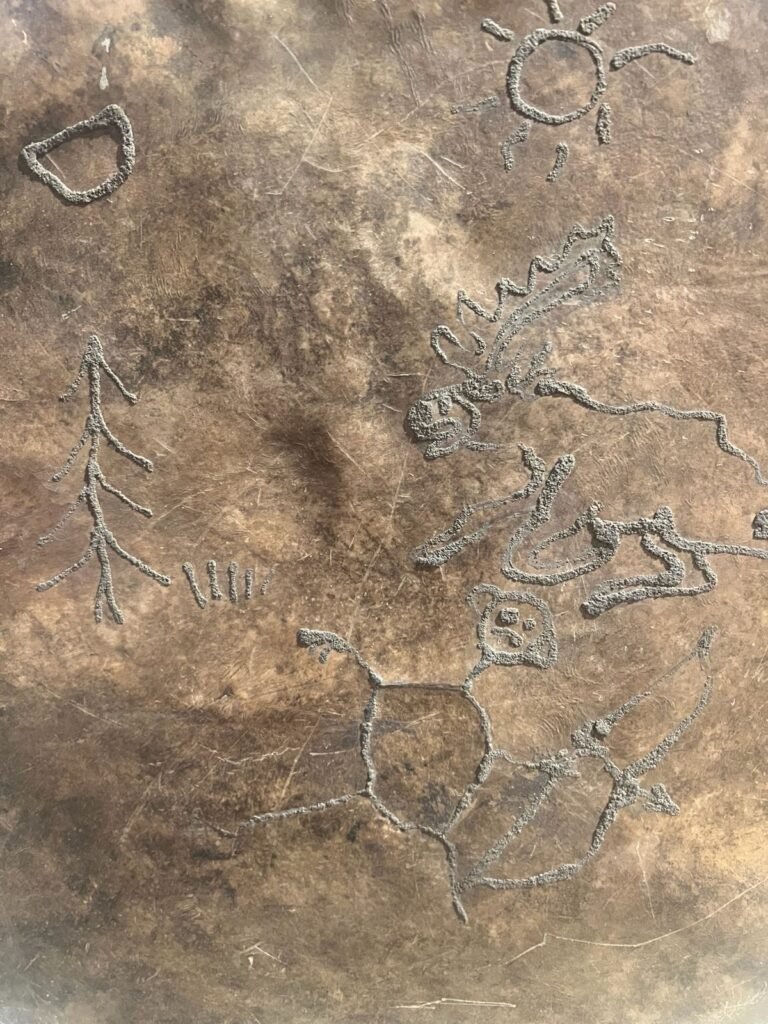
In Jean Rouch’s fieldwork with the Songhai, musical instruments such as the one-string fiddle produce low, raspy sounds understood within the ritual context as a form of communication with spirits. The music is not primarily there to satisfy an abstract idea of musical beauty. It has a function within the ritual and can contribute to a shift in presence.
When you look closer at the Bushmen, healing rituals use song and dance to induce trance in the healer and strengthen social cohesion. Music is an integral part of their lives.
Rouget means this when he insists that: “Trance is never simply the effect of music. It is the product of a relation: between the subject, the sound, and the symbolic context that activates it.”
Music Between Healing and Crisis
The Bible also offers a striking case: David playing the lyre for King Saul. In one episode, the music calms Saul’s anguish; in another, Saul tries to kill David while he plays. Music, here, is not neutral. Jules Combarieu’s discussion of music and magic reflects this wider ambivalence: music can participate in experiences of regulation and relief, but also in states of disturbance.
Sound as Situation
What links Plato, Aristotle, Al-Ghazali, and the ethnographers I’ve mentioned is a common intuition: music never acts alone. It becomes meaningful and effective when it enters a symbolic order and speaks through bodies, histories and ritual frames.
Trance, then, is not the automatic result of sound. It is a situated state activated by the convergence of sound, intention, memory and gesture. The same is true when we approach ecstasy. The distinction between the two remains useful, but the examples discussed here also show that human experience does not always respect perfectly defined categories.
Whether feared, regulated or deliberately sought, these altered states reveal how music does not merely reflect a world. It participates in constructing one.
Continue the series
- From Ecstasy to Trance: an exploration (Part 1) – where this series begins: Gilbert Rouget’s distinction between ecstasy and trance, and why the two sit on a continuum rather than in separate boxes.
- Introducing Trānsitiō – how the ideas in this series became a piece of music: the first sound journey in the collection From Ecstasy to Trance.
- Trānsitiō – listen to the 27-minute sound journey itself.
When a number is asked to explain too much
The question running through this article, whether sound acts on its own or only within a situation, comes back whenever a specific frequency is credited with a specific power.
- 432 Hz: between fascination and disillusionment – what happens when one tuning is asked to carry a cosmology.
- The hidden confusion around chakra frequencies – where the numbers assigned to the body’s energy centres actually came from.
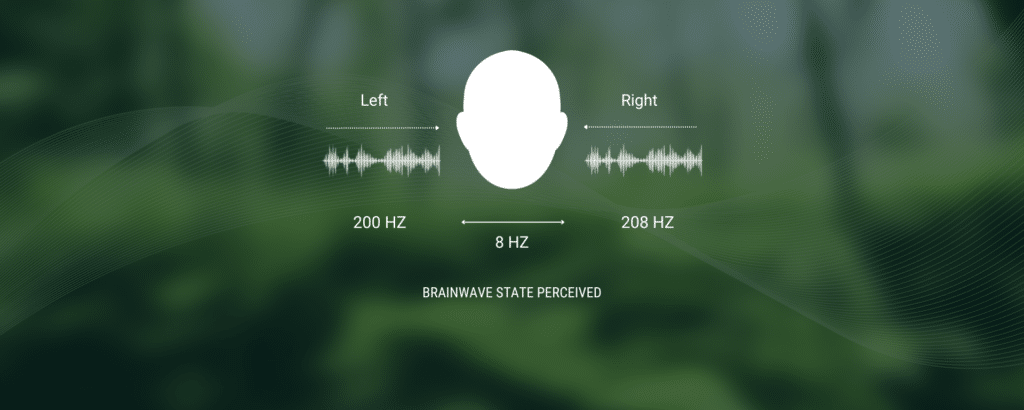
- Binaural beats: a simple explanation – what the effect is, and what it is not.
- Brainwaves and binaural beats – the entrainment claim examined more closely.
Ritual, listening and the body
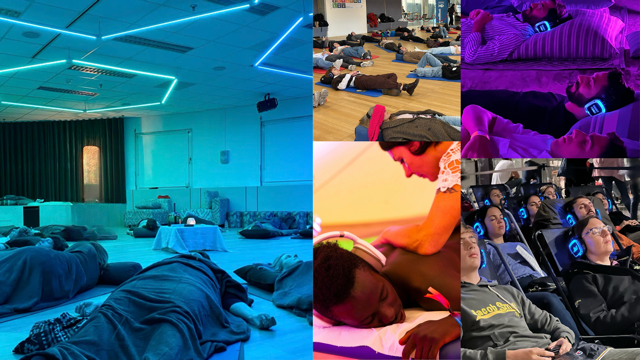
- More about sound baths – a contemporary ritual use of sound, and what people are actually doing in one.
- Full energy body scan: a sound bath – the practice itself.
- Why perception matters – why the same sound does not land the same way twice.
- Searching for silence – the condition Rouget associates with ecstasy, and how hard it has become to find.
- What is cymatics: sound made visible – sound as a physical, shaping force.
- Modern well-being through sound – where this research meets everyday listening.
References
- Al-Ghazali. Ihyaʾ ʿUlum al-Din [Revival of the Religious Sciences], Book of Samaʿ.
- Aristotle. Politics, Book VIII.
- Samuel Baud-Bovy. “Le dorien était-il un mode pentatonique ?” Revue de musicologie, vol. 64, no. 2, 1978, pp. 153-180.
- Jules Combarieu. La musique et la magie. Paris: A. Picard et fils, 1909.
- Gilbert Rouget. La Musique et la transe: Esquisse d’une théorie générale des relations de la musique et de la possession. Paris: Gallimard, 1980. Music and Trance: A Theory of the Relations between Music and Possession. Trans. Brunhilde Biebuyck. Chicago: University of Chicago Press, 1985.
- Jean Rouch. La religion et la magie Songhay. Paris: Presses Universitaires de France, 1960.
- Lorna Marshall. The !Kung of Nyae Nyae. Cambridge: Harvard University Press, 1976.
- Plato. The Republic. Trans. G. M. A. Grube, revised by C. D. C. Reeve. Indianapolis: Hackett Publishing, 1992.
Frequently Asked Questions
What is this article about?
This article explores how ancient philosophy and Islamic mysticism understood the relationship between music, ecstasy and trance. Claudio Vittori examines how thinkers such as Plato, Aristotle and Al-Ghazali, together with ethnographic accounts discussed by Gilbert Rouget, approached sound, ritual and altered states of consciousness.
How does this article define “trance”?
Trance is not treated as a vague metaphor or simple musical rapture. It is described as a structured and relational state of consciousness that can arise through an interaction between sound, body, intention, cultural meaning and ritual context.
The article also considers the distinction between trance and ecstasy. Rather than assuming that every altered experience fits neatly into one category, it explores how some ritual and mystical practices can display characteristics associated with both.
What do Plato and Aristotle say about music and trance?
In The Republic, Plato distinguishes musical modes according to their moral and emotional significance. He retains both the Dorian and the Phrygian, associating them with different forms of behaviour and social experience.
Aristotle later disagrees with him. In Politics, he criticises Plato’s retention of the Phrygian mode and describes it as emotionally exciting, associating it with the aulos and Bacchic frenzy.
For both philosophers, although in different ways, musical forms could have consequences extending beyond sound itself into behaviour, education and social order.
What does Al-Ghazali say about music and spiritual experience?
Al-Ghazali offers a qualified defence of samaʿ, or spiritual listening. A beautiful voice, melody and rhythm can interact with meaningful words and with the listener’s existing emotional and spiritual disposition.
The important point is that sound does not operate alone. The quality of the voice, the meaning of the words, familiarity, expectation and the listener’s internal state all participate in the experience.
This can result in wajd, a term frequently translated as ecstasy but associated with experiences that can also display characteristics we might describe as trance-like. This makes the boundary between ecstasy and trance particularly interesting in the Sufi context.
Why are the dervishes relevant to the distinction between ecstasy and trance?
Practices associated with dervishes complicate a simple opposition between the two states. Music can be performed and heard while participants sing, play, move or dance.
Depending on the moment and the individual, the experience can involve inward absorption as well as highly visible bodily and emotional activation. The distinction between ecstasy and trance remains useful, but these practices show that the phenomenology can contain shades of both.
What role does music play in ritual and healing?
Drawing from Gilbert Rouget and ethnographic studies, Vittori emphasizes that music alone does not cause trance. Instead, it becomes effective when embedded in ritual, symbolism and social practice.
Among the Songhai and Bushmen, for example, music participates in healing and spirit ceremonies and forms part of larger systems involving movement, belief, social relations and ritual meaning.
How does the Bible relate to this theme?
The story of David and King Saul illustrates the dual potential of music to calm or to accompany states of disturbance. It reflects the wider idea explored in the article that musical experience cannot be reduced to a single predictable effect.
What is the central idea of “From Ecstasy to Trance”?
The series argues that music is not just sound. It is a situated practice that interacts with identity, spirituality, embodiment and states of being.
“From Ecstasy to Trance” investigates how cultures ritualize sound and how voice, music, movement, expectation, memory and meaning can converge in experiences that move across different forms of altered consciousness.
Why is this topic important to Flower of Sound?
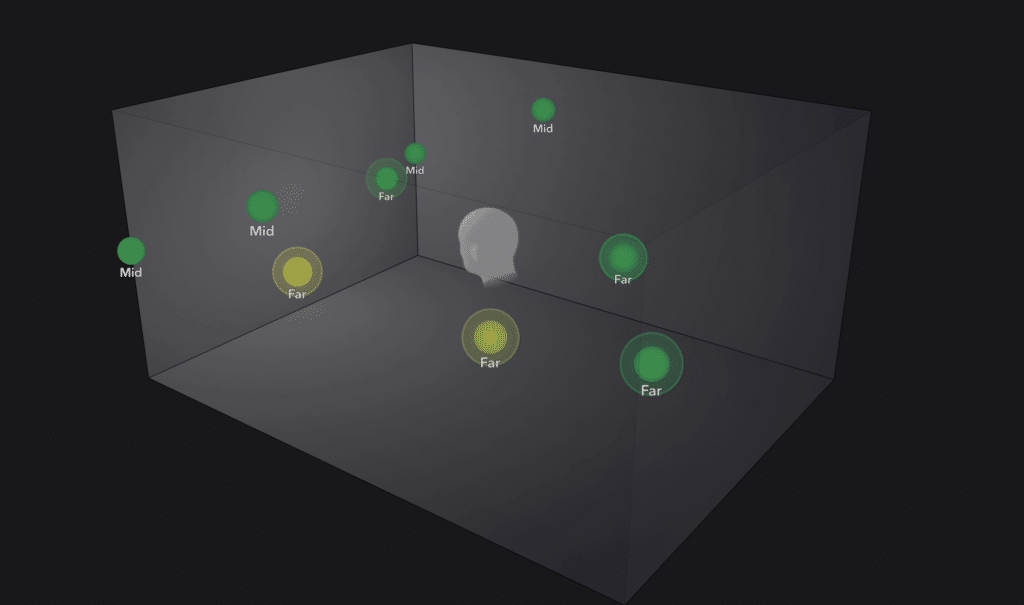
At Flower of Sound, “From Ecstasy to Trance” is one of the core conceptual pillars. The project explores how immersive and spatial sound can contribute to experiences of well-being, transformation and expanded awareness, while remaining attentive to the cultural, historical and perceptual contexts in which sound acquires meaning.
What sources does the article reference?
The text draws from Plato, Aristotle, Al-Ghazali, Gilbert Rouget, Jean Rouch, Samuel Baud-Bovy, Jules Combarieu and Lorna Marshall, combining philosophy, anthropology, ethnomusicology and mysticism to explore the relationship between sound and altered states